
When learners can “get behind” each concept, the educational content is enhanced. Images are not the same as a place, which can reveal relationships that images cannot. 3-D spaces can be used to support architecture, geography, history, science, design, and storytelling. They support students in making links between objects, distance, structures, and events in one context. During a classroom activity, you can take the explanation one step further and lead a guided visual discovery. This helps you to make the subjects easier to observe, compare and discuss. The concept of a future ByteDance world-model is shown here, where lesson ideas would be turned into explorable environments. It’s not a classroom platform that’s out there. Pippit offers a working process for creating educational video stories and references for scenes. Story Studio can help to plan lesson narratives, and Creative Canvas can help with scene direction.
Why Spatial Learning Can Change the Structure of a Lesson
Information can be presented using an AI video generator; spatial learning provides a meaningful context. It’s important to show a volcano, but it’s more impactful to put it in an ecosystem. Students are able to observe the terrain, water, vegetation, settlements, and the atmosphere all at once. Because every object has a visible role, it is easier to discuss connections in the context. Perspective also helps to show scale, distance, structure, and potential cause-and-effect relationships. Learners can explore the environment from multiple perspectives. That change can expose details which may not be seen at a single angle. Rather than being narrated to, students can examine evidence within the scene to arrive at each conclusion. The teacher can lead with questions and comparisons. This is a way to do active observation without making all of the lessons a game.
What the 3D World Model Could Mean for Educational Content
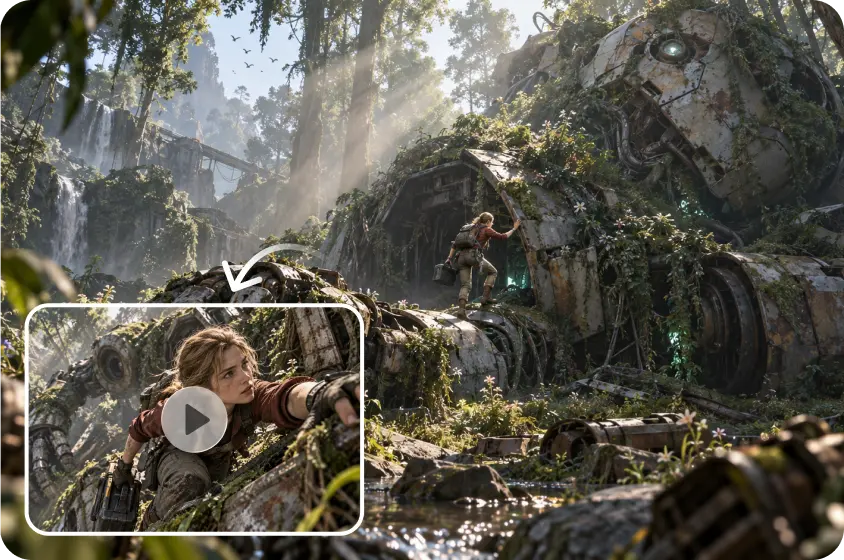
The Seeworld concept indicates a new way of creating spatial content. It’s billed as a new ByteDance direction in the world. It has not been made public as a classroom product. So the following uses are not yet guaranteed, but still possible. A 3D perspective with a navigable view may allow learners to examine environments from various perspectives. Layout control may be used to intentionally place objects of learning in foreground and background areas. White-mesh views might highlight geometry, depth, scale, and relationships between structures, but not in a decorative way. Reference-guided generation might involve converting visual references into suggested lesson settings. Sequenced scenes might depict a series of objects that exist in the same environment. These possibilities could be used for architecture studies, ecosystem exploration, historical reconstruction, laboratory planning, and design exercises. Final capabilities and availability in the classroom are not confirmed until official release information is available.
Turn a Curriculum Topic Into a Spatial Story
Always begin by establishing the learning objective and then select the visual details. Determine what students should know, compare, see, explain, or recreate. Then choose an environment that exists in nature that symbolizes the concept. A laboratory is appropriate for experimental science, and a historical street is appropriate for social studies. Biology, geography, climate, and environmental relationships can all be related to one another in an ecosystem. A fiction setting can be used to aid story and design. Then, use visual anchors for key concepts. Key concepts can be represented by objects, characters, signs, structures, paths, and environmental details. Their location should be designed to make relationships apparent. A teacher can arrange scenes of introduction, observation, and reinforcement. So this is the process of converting a topic into a spatial story with purpose.
Steps to Build Explorable 3D Lessons From Ideas
Step 1: Shape Your Educational Journey
- Sign up for Pippit with Google, TikTok, or Facebook information before developing your interactive lesson.
- Open the “Story Studio” tab from the left vertical menu to start planning your experience.
- Upload your lesson script using “Upload script”, or choose “Paste script” to insert learning content.
- Use “AI scriptwriter” from the top menu to generate scripts around concepts, subjects, or activities.
- Select an appropriate visual teaching style through “Style library” at the dialogue box’s bottom-left area.
- Choose your lesson format through “Default ratio”, then use “Episodes” for separate learning sections online.
- Finally, click “Generate” so AI can develop your lesson script and organize its learning sequence.
Step 2: Build Interactive Lesson Assets
- Use “Creative Canvas” to add images, scene videos, audio, and characters that support each lesson.
- Write prompts covering character appearance, settings, lighting, camera angles, styles, voice tones, moods, and context.
- After assigning roles and generating characters and scenes, click “Batch generate” to create lesson episodes.
Step 3: Review and Refine Learning Scenes
- Review each episode and refine characters, roles, scenes, and audio for clearer educational explanations overall.
- When satisfied, click “Select all”, then “Download” to save generated lesson episodes onto your device.
Six Design Principles for Explorable Educational Scenes
Purposeful structure, not visual overload, is crucial in creating strong educational scenes. Execute these principles in order to keep the exploration in line with learning goals:
- Learning Objective First: All visuals should support something that students need to learn.
- Spatial Relationships Matter: Put objects in strategic locations where proximity aids in conceptual understanding.
- Guide the Learner’s Attention: Ensure that the important information is highlighted and that there are no distractions using framing and hierarchy.
- Maintain Environment Legibility: Give learners sufficient context for exploration without overwhelming them.
- Narrate Strategically: Use narration to communicate relationships that are not clearly conveyed through observation.
- Link Scenes to a Sequence: Ensure that all links between scenes add to learning, grow, demonstrate, or reinforce learning.
These guidelines are useful for achieving a balance between exploration and instructional clarity. Decoration must not distract from the learning task.
Pippit as the Bridge Between Lesson Planning and Visual Production
The Pippit’s Story Studio is able to arrange educational stories prior to the visual production. Creative Canvas has detailed direction for scenes, characters, audio, and reference. Aspect-ratio selection can be used to format content for various viewing situations. Episode generation can break up longer lessons into smaller instructional units. When results are not as strong as needed, educators can refine the assets. Downloadable outputs make classroom handoff or further editing easy. This workflow does not take the place of instructional planning. Relates the structure of the lesson to practical visual productions. Teachers can ensure continuity of storyline and continually create more elaborate visual explanations. The process is repeatable for production of lessons with similar structures.
Conclusion
Telling stories in space can provide a visual framework for challenging educational concepts. It can assist students in analyzing relationships rather than facts in isolation. Spatial thinking is useful in architecture, science, history, geography, design, and storytelling. The world-model direction is proposed for the future to deepen this approach. However, its classroom potential is still unclear, as the technology has not been released as an educational platform. Pippit is a practical workflow today to develop educational stories and scene references. That is not the strongest lesson; however, it is the most impressive in terms of visuals. It is the lesson in which all scenes have a clear learning purpose.