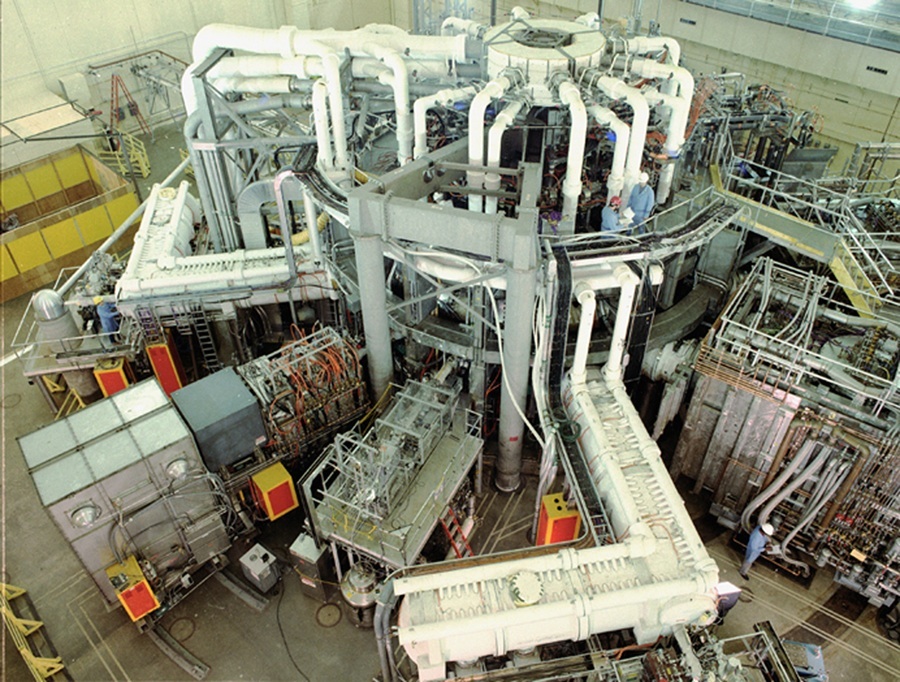
Fusion energy used to be funded the way cathedrals once were: by states, over generations, with completion dates beyond any single career. The past decade broke that pattern. Private fusion companies have raised billions of pounds from venture funds, energy majors and sovereign investors, and more than forty startups now pursue designs ranging from compact tokamaks to laser systems and magnetised targets. The flagship public project, ITER in southern France, continues as the field’s scientific anchor, while the International Atomic Energy Agency tracks a private sector that barely existed fifteen years ago. More investment analysis is available from our homepage.
What changed investors’ minds
Three developments unlocked the money. First, high-temperature superconducting tape matured, allowing much stronger magnets in much smaller machines, which collapsed the projected cost of a prototype reactor. Second, landmark experiments delivered results: magnetic confinement devices set energy records, and a laser facility in California repeatedly achieved fusion ignition, producing more fusion energy than the laser energy delivered to the fuel. Third, climate policy created a visible market. Governments hunting firm, zero-carbon power to complement wind and solar began signing the regulatory frameworks and research partnerships that make a future revenue stream imaginable, and imaginable revenue is what private capital requires.
Investors have learned to interrogate milestones rather than promises. The questions are technical and specific: has the magnet been tested at full field, has plasma performance matched the simulations the business plan rests on, and is there a credible route to a machine that produces more energy than the whole plant consumes, not merely more than the heating systems deliver? Our investment coverage notes that the strongest companies publish peer-reviewed results and submit to external review, because in a field with this history, verified physics is the only marketing that persuades serious money.
The risks are the timetable kind
Fusion’s investment risk is rarely that the science is fraudulent. It is that engineering at the edge of materials science takes longer than pitch decks assume. Reactor walls must endure years of neutron bombardment; tritium fuel must be bred inside the machine in quantities never yet demonstrated; and every component must eventually be manufacturable at a price a utility will pay per megawatt hour. A startup can clear each scientific hurdle and still lose to the calendar, burning its funding before the demonstration plant that would unlock the next, larger round.
Portfolio logic explains why investors accept those odds. The prize for the first mover that reaches economical fusion is not a niche product but a foundational technology for industry, desalination, shipping fuel and grids worldwide, licensable everywhere energy is used. Even partial success pays: advances in superconductors, robotics for extreme environments and plasma control already sell into other industries. Sovereign funds, meanwhile, are buying strategic position as much as financial return, ensuring their countries host the factories and skills if the technology lands.
How to read the next decade
The honest way to follow fusion investment is to watch construction, not conferences. Concrete poured, magnets delivered and tested, first plasmas achieved on the dates companies themselves set: those are the data points that separate the field’s leaders from its storytellers. Several demonstration machines are due to answer those tests before 2030. If even one performs as designed, fusion will complete an unlikely journey, from state megaproject to investable industry, and the long game its backers have played will start to look less like faith and more like foresight.
Public money has not left the stage; it has changed roles. Governments increasingly act as anchor customers and infrastructure partners, funding the test facilities, materials programmes and regulatory work that no single startup could justify, while letting private firms compete on reactor design. Britain, the United States, Japan and Germany all now run programmes explicitly intended to put a fusion plant on home soil in the 2030s or 2040s, and site competitions have mayors lobbying for reactors the way they once lobbied for car factories. For investors, that public scaffolding reduces some risks while adding political ones, since priorities change with elections. The blended model, state patience underneath private urgency, is probably the only one equal to a technology this expensive. It is also, not coincidentally, how aviation, semiconductors and the internet itself were built.