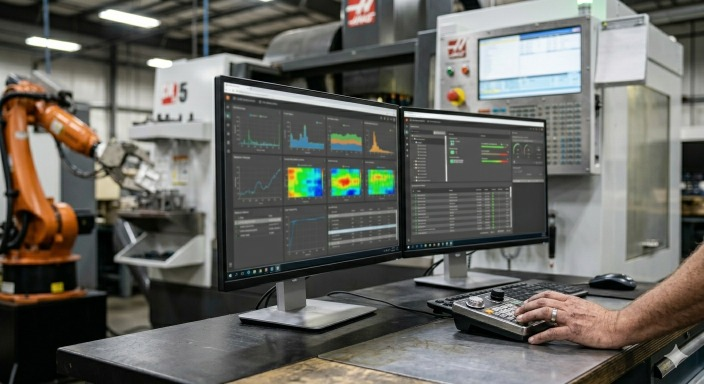
Manufacturing has always been capital-intensive. Machines are expensive, skilled labour is scarce, and the margin for error in high-value components continues to shrink. What has changed in recent years is the calculus around automation. CNC automation, once viewed as a costly upgrade reserved for the largest producers, has become a baseline requirement for manufacturers seeking to remain competitive. The reasons are straightforward: automation improves throughput, reduces variability, and enables the kind of consistency that modern industries demand.
The Business Case for CNC Automation
The financial rationale for automation is compelling. Studies of automated machining operations consistently show significant improvements in throughput and cost reduction. One automotive parts manufacturer reported a 40 percent reduction in production time, a 25 percent decrease in operational costs, and a drop in defect rates from 5 percent to 0.5 percent after implementing CNC automation. Another precision machining facility achieved a 47 percent improvement in machine utilisation and a 53 percent reduction in total downtime costs over a three-year period, with return on investment reached within the first year.
These figures are not isolated. A manufacturer that deployed robotic component loading on a five-axis machining centre increased production output by 500 percent compared with manually loaded machines, while the labour cost content of components fell by a factor of five. The machine ran 100 hours per week instead of 40, and the operator was required for only 20 percent of their time.
For business leaders evaluating capital allocation, the implication is clear. Automation is not merely a productivity tool. It is a mechanism for converting fixed labour costs into scalable capacity, and for reducing the variability that drives scrap, rework, and customer complaints.
Quality Control Moves from Detection to Prevention
Historically, quality control was a separate step—a final inspection that caught defects before shipment. In an automated machining environment, quality is embedded in the process itself. In-process probing verifies dimensions between cycles, allowing the machine to compensate for tool wear automatically. Statistical process control tracks variation across production runs, identifying trends before they produce non-conforming parts.
The impact on defect rates is measurable. The automotive case study mentioned earlier saw defects fall from 5 percent to 0.5 percent—a tenfold improvement. Another implementation using Industry 4.0 technologies reported that product length dimensional errors dropped from nearly 55 percent per month to zero defects, saving thousands in annual production costs.
This shift from detection to prevention has profound implications for supply chain reliability. When quality is built into the process rather than inspected in at the end, customers receive parts that are consistent by design, not by chance. For regulated industries such as medical devices and aerospace, the documentation that automation generates—inspection records, statistical process control data, material traceability—becomes part of the quality record, simplifying audits and reducing compliance risk.
AI and Adaptive Control Drive Further Gains
Artificial intelligence is accelerating the automation trend. AI-driven machining uses real-time sensor feedback to adjust feeds, speeds, and toolpaths automatically, responding to vibration, load, or temperature changes as they happen. The result is more consistent surface quality, lower tool wear, and fewer production halts.
Digital twin technology is emerging as another critical enabler. A digital twin is a virtual replica of a physical machine or process. Engineers use these models to simulate machining operations before the first chip is cut, identifying potential problems and optimising parameters without interrupting production. When the physical machine runs, sensors feed data back to the digital twin, creating a continuous learning loop that refines future performance.
For manufacturers producing complex components, these technologies translate into fewer surprises, shorter lead times, and higher first-pass yields. They also reduce reliance on a shrinking pool of expert operators. AI-powered CAM software can analyse a 3D design file and automatically select cutting tools, sequence operations, and generate ready-to-run machine programs, cutting programming time by up to half.
Automation in Precision Swiss Machining
Swiss-type machining, originally developed for watchmaking, has become a preferred technology for complex, high-tolerance components. The guide bushing design supports the workpiece immediately next to the cutting tool, eliminating deflection and vibration. When combined with automation—robotic part handling, automated bar feeders, in-process probing—the result is a manufacturing system capable of running unattended for extended periods while maintaining micron-level tolerances.
Manufacturers seeking to leverage these capabilities often partner with specialists who have invested in both the equipment and the process knowledge. A provider with advanced Swiss machining capabilities brings together multi-axis turning centres, automated material handling, and rigorous quality systems to deliver components that meet the most demanding specifications. These partners support industries including medical devices, aerospace, electronics, and automotive, where failure is not an option.
For those new to the technology, understanding the full scope of what Swiss machining can achieve is essential. A comprehensive Swiss machining manufacturing guide can provide detailed insights into material selection, tooling strategies, and quality control protocols, helping engineers and procurement professionals make informed decisions about their manufacturing partners.
The Labour Equation
The persistent shortage of skilled machinists has made automation a strategic imperative. Precision machining consistently ranks among the hardest positions to fill because the trade requires years of on-the-job mentoring. As experienced machinists retire, the gap widens. Automation offers a practical response. Robot-tended CNC cells, automated pallet changers, and self-calibrating tool presetters reduce the need for manual intervention on routine tasks. Lights-out machining—unattended production supported by smart scheduling and remote monitoring—enables shops to run around the clock with minimal staffing.
For business leaders, the math is straightforward: automation closes the labour gap while improving consistency and throughput. The shops that have invested in these technologies are better positioned to capture demand, maintain quality, and grow their businesses.
Looking Ahead
The digital transformation of manufacturing is still in its early stages, but its trajectory is clear. Over the next decade, the gap between automated leaders and laggards will widen substantially. The companies that invest in connected equipment, AI-driven process control, and automated systems will capture the most demanding programs and build the strongest customer relationships.
For manufacturers, the message is unambiguous. CNC automation is not a technology project—it is a strategic imperative. The organisations that connect technology, people, and processes to turn insight into better decisions will achieve stronger performance and greater resilience. Those that do not will compete for increasingly scarce commodity work.
In an era where every component matters, the combination of advanced automation and proven process expertise has never been more valuable. The companies that embrace this reality will lead their industries forward. The others will struggle to keep pace.